Book Appointment Now
Why We Eat and How to Take Back The Control
Overweight.. Scientifically, we say someone is overweight, when their BMI falls into a specific range. If someone is engaged in bodybuilding, they know, it is a bit more complicated.
But for now, let’s stick with it.
Collecting more fat than what is comfortable for you around your body is a very complex journey, not just calories, but lifestyle habits + biological processes moreover.. Even “unsolved traumas”.
So it also requires…I know, unfortunately… a complex solution.
Let’s start with your brain.
Have you ever wondered why you sometimes crave chips or chocolate even when you’re not truly hungry? The answer lies deep within the brain — in a complex network of regions that evolved long before supermarkets and snack aisles ever existed.
Your appetite isn’t controlled by one single part of your brain, but by a conversation between three powerful systems: the Cortico-Limbic System, the Hindbrain, and the Hypothalamus. Together, they decide when you eat, what you crave, and when you stop.
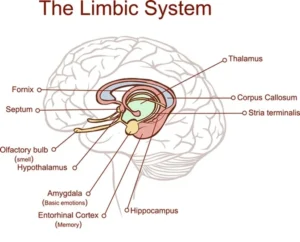
1. The Cortico-Limbic System – The Emotional Brain
This is your “cognitive and emotional brain.” It interprets how food smells, tastes, and feels — and it links those sensations to emotions and memories. When you bite into something creamy or sweet, it’s the cortico-limbic system that lights up, releasing opioids that make you like what you’re eating and dopamine that makes you want more.
Long ago, this system helped humans survive. Fat, sugar, and salt were precious and rare. Sweet honey was available only in certain seasons. Fat was hard to come by from wild animals, and salt often came just from water sources. So our brains evolved to find these foods intensely pleasurable — a built-in motivation to keep seeking nourishment in times of scarcity.
But today, the food landscape has changed drastically. Modern processed foods are engineered to overstimulate these same pleasure pathways, delivering far more dopamine and reward than our brains were ever meant to handle. Animal studies show that this hyper-rewarding stimulation can overwhelm our system, driving binge-like behaviors and affect us like drugs.
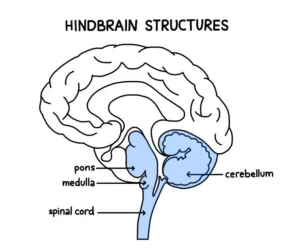
2. The Hindbrain – The Metabolic Brain
While your emotional brain reacts to pleasure, your hindbrain — or “metabolic brain” — quietly monitors your body’s internal state. It detects how much and what kind of nutrients are entering your gut, helping determine when you’re hungry and when you’re full.
Refined grains, added sugars, and processed fats confuse this system. Your stomach’s stretch receptors respond to volume, not calories — so you feel full based on how much space food takes up, not how energy-dense it is. Because processed foods are calorie-dense but low in fiber, you end up eating far more before your stomach signals fullness.
There’s another layer to this: your gut also senses nutrient quality. If what you’re eating lacks essential nutrients — as many processed foods do — your brain keeps urging you to eat, seeking what’s missing. Over time, this nutrient deprivation can trigger hormonal and metabolic changes that make weight regulation even harder.
In animal studies, rodents fed high-saturated-fat diets developed inflammation and nerve damage in the hypothalamus — the brain’s command center for appetite and energy regulation. These damaged neurons became resistant to leptin, the hormone that signals fullness. As a result, the animals kept eating, stored more fat.
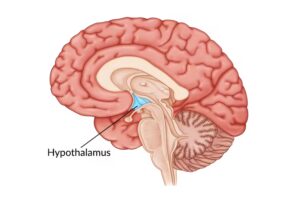
3. The Hypothalamus – The Command Center
At the crossroads of it all sits the hypothalamus — the brain’s control hub for appetite and energy balance. It integrates signals from both the emotional and metabolic systems, trying to strike a balance between what your body needs and what your mind wants.
But here’s the catch: your cognitive and emotional brain can easily override the metabolic one. That’s why you can keep eating dessert even after your stomach is full — your emotional drive for pleasure can drown out the quiet signals that say “enough.”
Genes?
Genetic research over the past decade shows that about 20% of body weight variation across people is linked to common genes. Each gene has only a small effect, and we each inherit a unique mix — meaning genetics influence our weight, but they don’t dictate it.
Most of these genes act in the brain, not the body. They influence appetite, energy balance, and food reward — shaping how much pleasure we get from eating and how quickly we feel full.
In other words, our genes can make it easier or harder to resist certain foods, but they only set the stage. Environment, habits, and food choices determine the rest.
How to start fixing these?
#1 – Diet
REDUCE the Processed Foods.
Processed foods are those altered from their natural form for convenience, flavor, or shelf life.
While lightly processed items (like frozen vegetables or plain yogurt) can still be healthy, ultra-processed foods are a different story.
A lot of these foods nowadays were created to make you addicted to eating.
Of course. They can be preserved for longer, be safer or even be more nutritious, it’s not all evil.. But it is important to note, uor rewarding system can’t handle them most of the time.
These foods override your natural hunger cues, making it easy to eat past fullness — one of the biggest drivers of weight gain and metabolic imbalance.
The USDA estimates 87% of the additional calories we are eating are from grains, added oils and fats, and added sugars and sweeteners. All calorie-dense ingredients commonly found in processed foods.
Examples of processed foods:
- Packaged snacks and sweets (chips, cookies, candy)
- Sugary cereals and sweetened drinks
- Fast food and fried foods
- Processed meats (sausages, bacon, deli meat)
- Refined grains (white bread, pasta, pastries)
Avoiding process foods is one of the most important steps you can take for maintaining a healthy body weight.

Increase Whole Foods
Whole foods are foods close to their natural state —
They don’t contain additives or preservatives, and they don’t include a long list of ingredients.
They are rich in fiber, vitamins, and minerals, with balanced amounts of fat, sugar, and salt. They support healthy appetite regulation, helping your body sense when you’re full.
Whole foods also contain natural amounts of fat, sugar and salt. They don’t override your appetite hormones, and drive you to eat past the point of feeling full
Eating mostly plant-based whole foods also lowers inflammation and supports long-term energy balance.
They contain health promoting chemicals found only in plants called phytonutrients. These include antioxidants and anti-inflammatory compounds, as well as ones I can turn on good genes and turn off our bad genes. The fiber in many plant-based whole foods also feeds our good gut bacteria. (I talk about these in an another post)
Examples of whole foods:
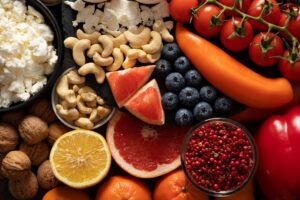
- Fresh fruits and vegetables
- Whole grains (quinoa, oats, brown rice)
- Legumes (beans, lentils, chickpeas)
- Nuts and seeds
- Fish, eggs, and unprocessed meat
An abundance of studies concur that eating a whole food’s dietary pattern is the safest way to manage your weight. Eating whole foods isn’t a diet per se, it’s a lifelong framework from which foods you should eat and which ones you should avoid.
The best way is to write a Diet-diary.
- Write down what you eat 2-3 days a week…
- Then next week, try your best to limit the processed food and add a whole food instead of them.
- This requires planning and discipline.
- If you need help with that, book a consultation, and I can help with this.
- But with enough dedication, you can do it by yourself too.
So many diets can be found on the internet, as “the solution for YOUR problem.”
But our lifestyles, biology, therefore solutions are all a bit different.
In the 1970s, low-fat diets became the craze. By the 1990s, fat intake (as a % of calories) dropped — but obesity kept rising. Why?
We didn’t actually eat less fat — we just replaced it with refined carbs and sugars in “low-fat” cookies, snacks, and processed foods. Our total calorie intake soared.
To settle the debate, Harvard researchers (2009) ran a large clinical trial comparing low-fat, low-carb, and other balanced diets.
👉 Result:
-
- All diets led to similar weight loss — about 3–4 kg on average.
- You can lose weight on many diets, but if you don’t change your lifestyle you’ll gain it back.
- It’s not about fat vs. carbs — it’s about the quality of what you eat.
- Choose healthy fats (mono- & polyunsaturated) over saturated and trans fats.
- Choose complex carbs instead of simple ones.
Why Calories Aren’t the Whole Story
Counting calories follows the first law of thermodynamics — energy in vs. energy out — but this oversimplifies how humans actually work.
Our metabolism and weight are also shaped by stress, exercise, and sleep, which all influence hormones that regulate appetite, fat storage, and energy balance.
Stress
Chronic stress activates the HPA axis (hypothalamus–pituitary–adrenal pathway), releasing cortisol, the “stress hormone.”
Cortisol prepares the body for action — increasing hunger for quick-energy foods (sugar and fat).
Because we rarely “burn off” that energy, these calories get stored — especially as belly fat (visceral fat).
Visceral fat is metabolically active: it releases inflammatory chemicals and increases insulin resistance, creating a cycle of more fat storage and higher “set point.”
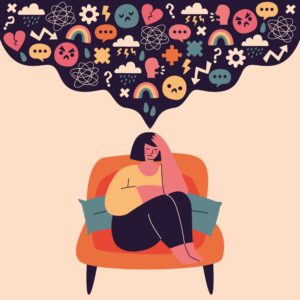
Stress also drives emotional eating, as dopamine from comfort foods briefly soothes the brain’s stress response.
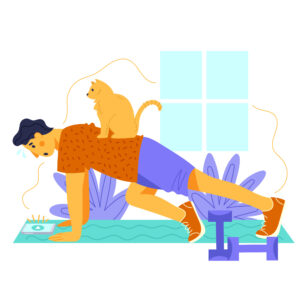
Exercise
Exercise does more than burn calories — it reshapes metabolism:
- Builds muscle, which burns ~3× more calories than fat.
- Reduces cortisol and inflammation.
- Triggers the release of myokines, chemical messengers from muscle that counteract the harmful effects of excess fat.
Even small movements matter. Sitting for long periods shuts down muscle activity, slowing glucose and fat metabolism.
Standing or walking for a minute every hour can lower blood sugar, cholesterol, and waist size — proven in research on sedentary workers.
When at work:
- Stand up to take phone calls.
- Go for a walk at lunch.
- Take the stairs.
- Walk to the break room, water cooler, or restroom every 90 minutes. (Set an alarm on your phone so you don’t forget.)
- Stretch/exercise at your desk.
- Have a question for a coworker? Walk to their desk instead of sending an email.
When at home:
- Play fitness-oriented video games
- Dance around your house just for fun.
- Clean. (It counts as exercise.)
- Play with or walk your pets.
- Do a few sets of exercises (squats, lunges, push-ups, burpees, etc.) any time you have 5 minutes to spare, during commercial breaks while watching TV or in between episodes if you’re watching Netflix.
When out:
- Walk or ride your bike to your destination whenever possible.
- Park your car far away from an entrance when running errands.
- If you use public transportation, ride standing up. And if you have the time, get off one or two stops early and walk the extra distance.
- At the mall or department store, take the stairs and skip escalators and elevators.
- Schedule active weekend events like bike rides, park dates, or easy day-hikes.
Sleep
Sleep is the maintenance time for your metabolism.
When you don’t get enough quality sleep, your body’s hunger and energy systems go off balance.
Research shows that sleep deprivation:
- Increases ghrelin, the hormone that makes you hungry-> you feel more hungry.
- Decreases leptin, the hormone that signals fullness-> you feel less full.
- Raises cortisol, the stress hormone that promotes belly fat -> you store more fat
- Slows insulin sensitivity, making it easier to store fat-> you store more fat.
Together, these changes make you crave high-calorie foods, eat more, and burn fewer calories.
Getting 7–9 hours of quality sleep each night helps restore hormone balance, regulate appetite, and support healthy weight management — as effectively as diet and exercise combined… So maybe you just need to sleep better and you can already lose some of that unnecessary weight.
By now, you must understand that the answer is not in “calorie counting, and genes.. Or buying products”, but your lifestyle.

One more thing to remember….
Now you know, we don’t just eat because we’re hungry … we eat because of habits and environmental cues too.
Popcorn at the movies or beer during football are examples of automatic associations that trigger eating, even when we’re full.
Most of our daily actions are subconscious habits, not conscious choices. Our brain creates these shortcuts to save energy, so familiar sights, smells, or settings can cue us to eat without thinking.
Marketing and “food cues” (ads, smells, images) exploit this by linking foods to pleasure and reward — what researchers call “food porn.”
To manage weight effectively, we must:
- Recognize and reshape our environment to break unhealthy habits
- Build new automatic routines that align with our goals
- Use our conscious brain to design cues that lead to healthy choices
- Don’t fall into the trap of emotions and illusions that we created in connection with eating.
- Identify triggers that lead to overeating (like TV, smells, or social settings).
- Replace old cues with healthy routines — e.g., tea instead of snacks while watching a movie.
- Keep healthy foods visible and tempting; keep processed foods out of sight.
- Remember: Your environment shapes your choices. Make it work for you.
In my private lessons, we can talk about personal steps you can take in order to change your habits.
Resources:
United States’ Trends in Food, 1970-2014
Science Explains Why Processed Foods Make Us Fat
What Are Processed Foods & Which Ones Should You Eat?
Science Compared Every Diet, & The Winner Is Real Food
Why Stress Causes People to Overeat
7 Ways Mentally Strong People Deal with Stress
Does Exercise Help You Lose Weight?
How Exercise Helps Balance Hormones
10 Sneaky Ways to Incorporate More Exercise into Your Day
Here’s What Really Happens When You’re Sleep Deprived
How to Train Yourself to Go to Sleep Earlier
What Would Happen If You Didn’t Sleep?
Is Our Environment Making Us Eat More?
The Benefits of Home Cooking for Your Family
Emory University
https://www.news-medical.net/health/Limbic-System-and-Behavior.aspx
https://www.flintrehab.com/hypothalamus-brain-injury/srsltid=AfmBOoqvpNw08UrL9Wq8YgQwsmreRkrRXID5ZUKUrnokjEW6fRc_H1Z8