

The science of pro-inflammatory foods
In previous articles, we have detailed what happens at the cellular level when we talk about “inflammation”
and which foods help keep this in harmony.
If you haven’t read them yet, check them out!
Now we will discuss what are the Inflammatory Foods and why?!
The Evil, Evil “Refined Carbohydrates”
As we discussed earlier, glucose and vitamin C use the same “GLUT1” gate. When your blood is full of sugar, the gates are busy. Your immune cells can’t take in the vitamin C (which they need to fight off infections). So your immune system is left “unarmed” against free radicals (molecules that steal electrons from other molecules, damaging them), while the sugar-fueled inflammatory response is at its peak.
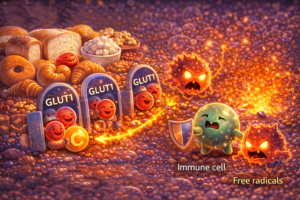
When glucose from refined carbohydrates suddenly floods the cell, the mitochondria (the powerhouses) are put into overdrive.
The cell tries to “burn” all the sugar at once, which overloads it. As a byproduct, a huge amount of superoxide free radicals are produced.
Free radicals are one of the primary contributors to inflammation, running rampant and stealing electrons from cells, damaging them and their function.
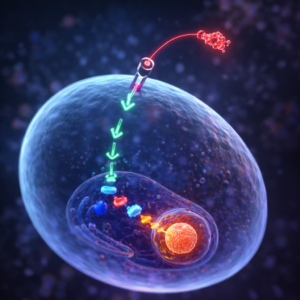
The large amount of free radicals immediately activates the enzyme IκB-kinase, which cuts the chain off the NF-κB messenger. NF-κB swims into the nucleus and triggers the production of inflammatory cytokines (e.g. IL-6), which results in even more inflammation and tells all other cells to start and maintain the inflammatory state! (see other article)
“Formation of AGE molecules” (Glycation)
High blood sugar levels cause sugar molecules to randomly “stick” to the body’s proteins (e.g. collagen, hemoglobin). This is called glycation.
At the cellular level: This creates AGEs (Advanced Glycation End-products), which are damaged, “sugared” proteins.
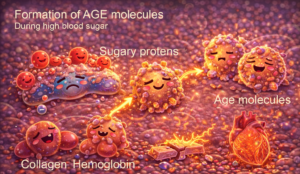
These “AGE molecules” lead to inflammation, structural damage, and oxidative stress, as they activate inflammatory pathways in cells. These can later manifest as chronic diseases.
The formation of “AGEs” is not only promoted by sugar, but also by foods that are fried and heated for a long time, at high temperatures, large amounts of processed foods, and large amounts of “bad” trans fats.
It’s as if we are letting in strangers who come and destroy the house from the inside.
We must mention our other important participant here…
“The Inflammasome”
The inflammasome is a key protein complex of the innate immune system that orchestrates the body’s defenses against infections and cell damage.
In a nutshell: it is the cell’s “security system” that recognizes danger and initiates a drastic inflammatory response (inflammation and cell death).
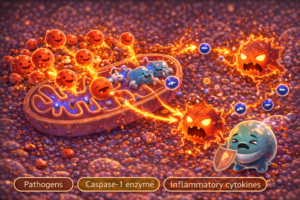
The inflammasome activates an enzyme called caspase-1, caspase-1 activates inflammatory cytokines, most notably IL-1β and IL-18, which alert the immune system, after which inflammatory messages spread throughout the body.
If the infection is too large, the inflammasome triggers cell death, which causes the cell to destroy itself and the pathogen inside it. (just how soldiers used to do “kamikaze”.
How do we activate the inflammasome through eating?
Fructose (Fructose Sugar) and Uric Acid:
Excessive fructose intake (soft drinks, syrups) causes the liver to produce uric acid. Uric acid crystals cause physical irritation inside the cell, which is one of the strongest direct activators of the inflammasome.
Oxidized Cholesterol (Oxysterols):
When LDL cholesterol in your blood becomes oxidized (e.g. due to smoking or trans fats), it is ingested by phagocytic cells (macrophages). The oxidized fat damages the cell’s internal “digestion chambers” (lysosomes), and this “internal leakage” triggers the inflammasome.
Saturated Fatty Acids (Palmitic Acid):
Excessive animal fat (red meat, butter) can directly activate TLR receptors on the cell surface, which “primes” the inflammasome to explode.
Burnt, overheated vegetable oils
(e.g. sunflower oil for multiple frying): Burnt, overheated vegetable oils (e.g. sunflower oil for multiple frying) These oxidized fats damage lysosomes (the digestive units of the cell). When the lysosome wall ruptures and its acidic contents leak into the cell plasma, it is one of the strongest activation signals for the inflammasome.
Even fats, specifically “trans fats,” have a couple of other problems. For example, trans fats and oxidized fatty acids from burnt oils physically incorporate into the lipid bilayer of the cell membrane. (Just like the omega 3 and omega 9 as we discussed earlier.) These fats are like a mutant fatty acid, like having your hand in place of your foot and your hand in place of your foot. The body cannot recognize them. These fats are “stiff” or have a damaged structure, so the cell membrane loses its elasticity and selective permeability and will not be able to function properly.
This structural defect activates membrane-bound NADPH oxidase (NOX) enzymes (see earlier) which in response begin to produce free radicals, triggering the inflammatory NF-κB pathway.
High sodium snacks (Salt overload):
Excessive salt intake changes the osmotic pressure of the fluid between the cells. The cell is forced to release potassium to equalize the pressure. However, low internal potassium levels are a classic chemical condition for the “arming” of the inflammasome.
Fiber-free baked goods made from refined flour:
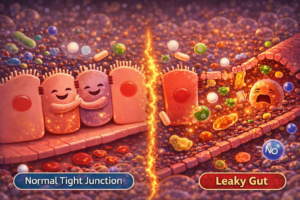
They lack the fiber needed for butyrate production (the “fuel, food” for intestinal epithelial cells). The intestinal epithelial cells are starved, the tight junction proteins between them loosen (leaky gut syndrome develops). This opens the way for bacteria, which, when they enter the blood, bind to the cell surface receptors, giving the command to assemble the inflammasome.
Alcohol (especially hard drinks):
The breakdown product of alcohol, acetaldehyde, is a direct cell poison! It inhibits the internal “cleaning” of the cell. Since the constantly produced debris is not cleaned up, it continuously stimulates the inflammasome, maintaining chronic inflammation.
The persistently activated NLRP3 inflammasome is a key driver of chronic inflammatory processes in the body
It contributes to the development or exacerbation of chronic diseases in large quantities.
For example
- For neurodegenerative diseases: Alzheimer’s disease, Parkinson’s disease and multiple sclerosis.
- For metabolic diseases: Type 2 diabetes, obesity and their complications (nephropathy, retinopathy).
- For cardiovascular diseases: Atherosclerosis and acute myocardial infarction.
- For autoimmune and inflammatory diseases: Rheumatoid arthritis, systemic lupus erythematosus (SLE), atopic dermatitis, gout and joint pain.
- For liver diseases: Non-alcoholic fatty liver disease (NAFLD).
- For tissue damage and functional impairment: Due to persistent inflammation, structural and functional deterioration occurs in the affected organs (e.g. joints, nervous system).
In summary, the inflammasome is responsible for the explosive initiation of the inflammatory response, and if it remains activated for a long time, it can also lead to chronic diseases.
And since our different eating habits increase the number of free radicals in our bodies, this also triggers other internal processes in the long term…
For example, there will be more
“Oxidized lipids”
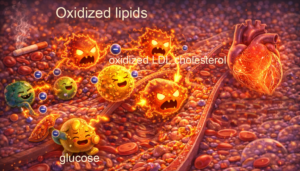
Oxidized lipids are fatty acids, cholesterol or phospholipids that have been oxidized (i.e., given up their electrons to free radicals) by reacting with free radicals, damaging cell walls and blood vessel walls. Their best-known form, oxidized LDL cholesterol, plays a key role in atherosclerosis, increasing the risk of cardiovascular disease.
They are formed when fats (lipids) in the body encounter free radicals, for example in cases of high cholesterol, smoking, high blood sugar, and obesity.
Red meat can also cause strange things if consumed excessively (not occasionally).
They contain substances that the body does not produce, so when it enters, it perceives them as foreign substances and starts to produce continuous inflammatory mediators against them.
You can learn more about this inflammatory process under the name “xenosialitis”.
Unfortunately, excessive amounts of them contribute to the development of cancer (especially colon cancer), cardiovascular diseases, and the exacerbation of autoimmune diseases, such as rheumatoid arthritis.
“Ultra-processed foods”
We hear this term more and more. “How far we have become from nature by eating plastic.” I will talk more about this topic in another article.
But what does this topic have to do with inflammation?
Ultra-processed foods are not only harmful because of the sugar or fat they contain, but also because they contain compounds that the human body has never encountered during evolution, so once again we are at the point where, since it is a foreign substance, the body defends itself against it, that is, it remains inflamed. It can easily cause changes, as if a new, problematic boss were added to a normally harmonious team.
In another article, I will practically present what specific foods are important to consume on a daily/weekly basis, and which ones are recommended to be avoided.
Sources
- pubmed.ncbi.nlm.nih.gov (NF-κB signaling in inflammation)
- www.ncbi.nlm.nih.gov (Curcumin and NF-κB inhibition)
- pubmed.ncbi.nlm.nih.gov (Cytokines: the language of the immune system)
- www.nature.com (Cytokine-storm: mechanisms and treatments)
- pubmed.ncbi.nlm.nih.gov (The role of IL-6 in chronic inflammation)
- www.sciencedirect.com
- pubmed.ncbi.nlm.nih.gov (The NLRP3 inflammasome and metabolic diseases)
- www.nature.com (NLRP3 inflammasomes and uric acid crystals)
- pubmed.ncbi.nlm.nih.gov (Mitochondrial DNA and inflammasome activation)
- www.ncbi.nlm.nih.gov (Nrf2: the master regulator of antioxidant response)
- pubmed.ncbi.nlm.nih.gov (Interplay between Nrf2 and NF-κB)
- www.cell.com (ROS and inflammation)
- pubmed.ncbi.nlm.nih.gov (Sugar-sweetened beverages and inflammation)
- www.bmj.com (Ultra-processed foods and health outcomes)
- pubmed.ncbi.nlm.nih.gov (Glucose-induced oxidative stress)
- www.nature.com (Dietary fructose and intestinal barrier)
- pubmed.ncbi.nlm.nih.gov (Emulsifiers and gut microbiota dysbiosis)
- www.ncbi.nlm.nih.gov (Dietary advanced glycation end products – AGEs)


[…] In the following article, we will explain which foods increase the chances of getting into a state of chronic inflammation. You can read a similar post of mine with less biology in a more digestible, practical form. […]
[…] foods can contribute to lower the level of inflammation on a cellular level. Later on we talk about the opposite, what kind of eating habits lead to disharmony and […]